

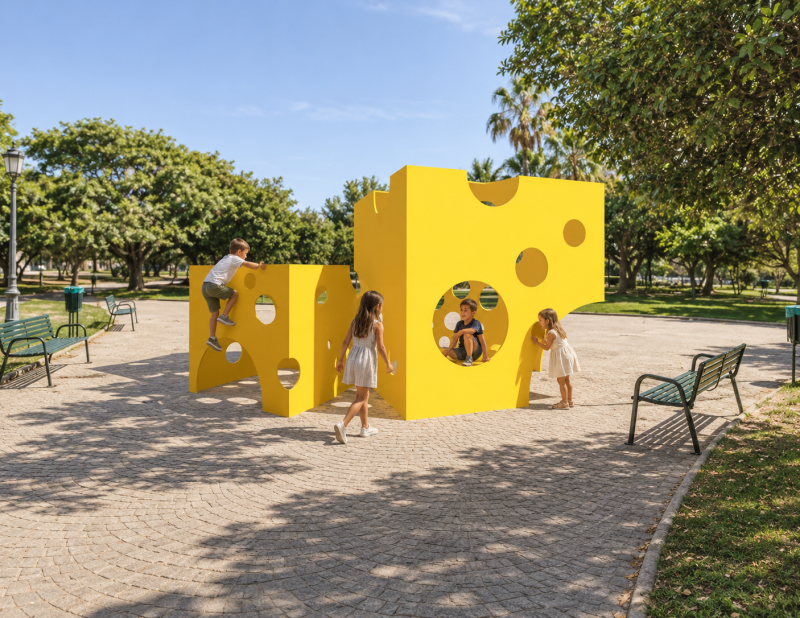
We often confuse maturity with an absence of color, and solemnity with technical rigor. Somewhere along the way, contemporary architecture and design decided that to be taken seriously, they had to strip themselves of any hint of spontaneity, movement, or play. The outcome is a daily landscape populated by sterile, grey, visually uniform spaces: environments that photograph well for a flat screen, but rarely spark an honest emotion when inhabited.
What we casually label as “childish” with a certain condescension actually addresses the most primary, profound, and intuitive mechanisms of our spatial perception. Reclaiming play, touch, and wonder is not frivolous; it is restoring our natural way of relating to the physical world.
The Trap of “Infantilization” (and a Lesson Learned)
A few years ago at the studio, we received a unique commission for a public space: designing a small house for the Tooth Fairy (el Ratoncito Pérez). Rather than falling back on cardboard kitsch or miniature residential cliché, we proposed an abstract, vibrant, uninhibited structure: a large, perforated, habitable wedge of cheese. It was an object designed to be climbed, traversed, discovered, and freely interpreted. An open invitation to curiosity.
The proposal was flatly rejected by public administrators. It failed to fit into bureaucratic assumptions of what it “ought to be.” Instead, they opted to install a traditional cottage with a pitched roof, a tiny chimney, and miniature windows.
That decision carried a telling paradox: in attempting to preserve institutional decorum, they slipped into genuine infantilization. It was assumed that a child’s—and human—imagination is flat, literal, and conservative. A stimulating spatial artifact was replaced by a figurative backdrop stripped of layers of meaning.
The fear of not being understood often pushes institutions, corporations, and sometimes architects themselves to retreat into the obvious. And within that retreat, spaces lose their vital pulse.
What Spatial Theory Teaches Us About Body and Play
Stripping spaces of play carries a quiet cost to collective well-being. This is not about turning our cities or offices into loud theme parks; it is about recognizing the haptic and phenomenological dimension of the built environment:
- Returning to the Senses (Beyond the Eye): In The Eyes of the Skin, architect Juhani Pallasmaa critiques how Western architecture has fallen into a sterile ocularcentrism, neglecting touch, gravity, sound, and bodily scale. When an object or space invites us to balance, engage in physical contact, or adopt an unprompted posture, it pulls us out of visual lethargy and reconnects us with our physical existence.
- Homo Ludens as the Foundation of Culture: Johan Huizinga demonstrated nearly a century ago that play is neither an incidental activity nor exclusive to childhood; it is the very matrix upon which civilization, abstract thinking, and social cohesion are built. An environment that denies spontaneous interaction and discovery is an environment that stifles creativity.
- Color as Matter, Not Ornament: Authors like David Batchelor in Chromophobia have dissected the historical panic within the architectural canon regarding bold color, condescendingly tying it to the primitive, the superficial, or the juvenile. Bringing color back is not decorating; it is qualifying light, demarcating emotional territories, and giving atmosphere its true character.
Modern living, keen thinking: Designing with Accent and Without Prejudice
At MLKT, we believe that designing a home, a workplace, or public amenities demands absolute commitment to daily life and how it evolves. Meticulous architectural craft and structural precision are never at odds with warmth, surprise, and joy. Real technical excellence only gains purpose when placed at the service of human empathy.
In an era saturated with interactions mediated by cold glass touchscreens, engaging with physical matter, discovering an unexpected spatial corner, or cracking a smile at a bold spatial solution has become an almost revolutionary act.
Designing spaces that support life also means designing spaces capable of celebrating joy. Fewer inert monuments, and more living places where play, memory, and tactile experience return to center stage.