

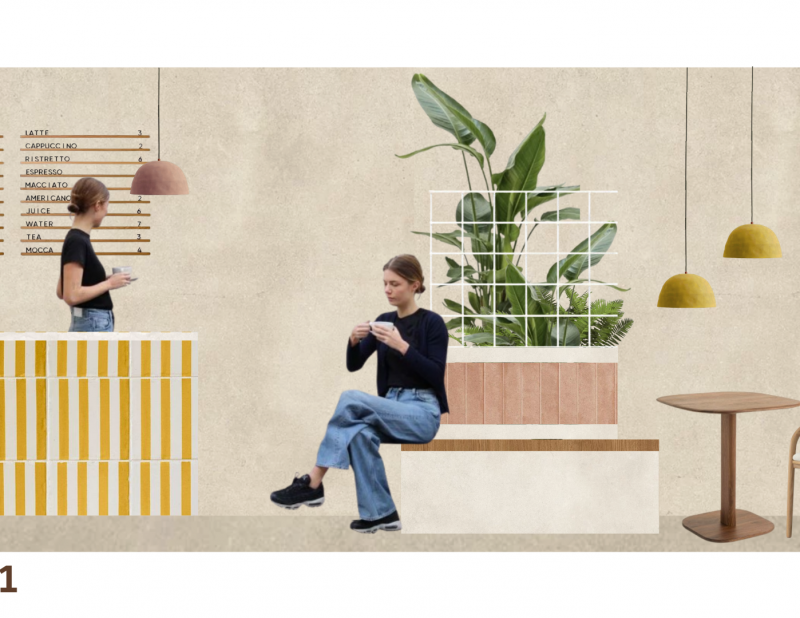
It is a situation we encounter frequently: during the presentation meeting where we introduce an innovative and aesthetically bold concept for a retail or hospitality project—intentionally setting it apart from the common, repetitive formulas of the sector—the initial client response, once the initial surprise is overcome, is genuine interest and enthusiasm for the new direction.
However, days later, we often receive that thoughtful phone call: doubts have emerged. The client genuinely likes the proposal, and the strategic arguments supporting the design make complete sense, but a natural feeling has surfaced—the fear of taking a risk.
The Trap of Generic Sobriety
The temptation to retreat into neutral territory is entirely human. The familiar provides a sense of reassurance, suggesting that replicating the aesthetic patterns of existing businesses minimizes risk.
Yet, in a competitive market like Malaga and the Costa del Sol, generic sobriety is not prudence: it is invisibility. Academic research on Atmospherics in Retailing (a concept pioneered by Philip Kotler and expanded by Baker, Grewal, and Parasuraman) demonstrates that when commercial spaces copy generic, neutral schemes from their competitors, they suffer a direct decline in brand recall, forcing the business to compete strictly on price.
When a developer or entrepreneur partners with a design and architecture studio like MLKT, their objective is not to compete on minimal price margins, but to generate substantial added value, build a memorable environment, and achieve immediate recognition among their target audience.
Three Evidence-Backed Reasons Why Distinctive Design Drives ROI
To transform uncertainty into confidence, creative intuition must be supported by market metrics and spatial neuroscience:
- Atmosphere Drives Over 70% of Perceived Value (Harvard Business Review): Research on customer experience indicates that a business’s physical environment (lighting, geometry, materiality, and spatial hierarchy) accounts for the vast majority of overall brand perception. A space devoid of character actively diminishes the perceived value of the product or service offered.
- The “Third Place” Concept (Ray Oldenburg): Commercial spaces that cultivate a distinct spatial identity transition from mere transactional points into “third places”—social hubs between home and work. This distinctiveness measurably increases dwell time and customer loyalty.
- Direct Return on Design Investment (Design Council UK): Empirical business data proves that companies embedding strategic design into their physical assets outperform their peers in market share and long-term customer retention, multiplying the commercial return of every euro invested.
Our Commitment: Guidance Without Imposition
At MLKT, we understand that stepping off the beaten path requires rigorous technical and economic support. Our role as architects is not to impose eccentric ideas, but to listen closely to our clients’ concerns, justify every detail through strategic reasoning, and ensure absolute cost and construction control.
The true risk for a retail, workplace, or hospitality project is not committing to a design with its own accent and identity; the real risk is investing significant resources into a space that nobody remembers.
Are you planning a new commercial space or office project in Malaga or the Costa del Sol?
At MLKT Design & Architecture, we design spaces that accompany life, evolve over time, and connect deeply with their users. [Get in touch with our team to explore your project’s potential].